








 TV Operators
  Healthcare
  Digital Signage
  Hospitality
  Education






 TV Operators
  Healthcare
  Digital Signage
  Hospitality
  Education


Managing a fleet of distributed devices, whether in education, logistics, hospitality, PayTV, or digital signage environments, has never been more complex or more critical. As organizations scale, the demand for robust mobile device management (MDM) platforms has grown exponentially. Yet, many traditional MDM security solutions struggle to meet the demands of modern requirements, including real-time telemetry, data protection, global reach, and non-negotiable uptime.
Enter Radix. Purpose-built for today’s demanding environments, Radix is more than an MDM, it’s a purpose-built, cloud-native device management platform designed for scale, resilience, and enterprise security.
This article examines what makes Radix the ideal solution for IT admins and operational leaders, providing a comprehensive overview of its cloud architecture, Kubernetes-based elasticity, CDN performance, and protection mechanisms that drive its exceptional performance.
The Problem With Legacy MDM
Legacy MDM platforms were architected in an era before the cloud, before edge computing, and certainly before zero-trust security was a baseline requirement. These systems are typically built on monolithic infrastructures, with a focus on device provisioning and policy enforcement. But they fall short in several critical areas:
- Scalability. As device counts soar into the tens or hundreds of thousands, traditional systems can’t keep up without significant manual intervention.
- Availability. Downtime means loss of visibility and control, an unacceptable risk in mission-critical operations.
- Security. Static perimeters, outdated encryption standards, and a lack of automated threat detection expose organizations to significant security risks, including breaches.
- Latency. In fast-paced environments, seconds matter. Legacy systems can’t deliver the sub-second responsiveness modern users expect.
Organizations that remain tethered to these outdated platforms are finding themselves increasingly vulnerable, inefficient, and unable to innovate.

What Radix Rebuilt: Cloud Architecture for 99.9% Availability
Radix didn’t just bolt new features onto an old chassis, it rebuilt the engine for enterprise-grade device management. At the heart of its MDM solution is a cloud-native, microservices-based architecture deployed across multiple global regions. This approach ensures high availability, resiliency, and fault tolerance that legacy systems simply can’t match.
Multi-Zone Cloud Deployment
Radix spans multiple cloud availability zones, ensuring automatic failover in the event of hardware or service disruptions. This design is critical for maintaining 99.9% uptime, even under adverse conditions such as natural disasters or regional outages.
Elastic by Design
Radix dynamically scales its services, up or down, based on demand, without impacting performance or availability. Whether managing 1,000 devices or 10,000, Radix ensures consistent responsiveness and resource efficiency.
Edge-Optimized CDN
To minimize latency and ensure fast, reliable content delivery, Radix utilizes a global Content Delivery Network (CDN) that caches both static and dynamic content at its edge locations. This means that firmware updates, device configurations, and security policies are delivered in near real-time, regardless of the device's location.
Security From the Ground Up: Zero Trust and Automated Threat Response
Radix doesn’t treat security as a feature, it’s embedded into every layer of the platform. Designed with a defense-in-depth strategy, Radix takes a holistic approach to security, blending robust architecture, intelligent automation, and proactive monitoring to safeguard every user, device, and data transaction.
Defense-In-Depth Architecture
MDM security at Radix begins with hardened infrastructure. From firewalled network layers and Web Application Firewall (WAF) protections to CIS-benchmarked server configurations, every component safeguards against intrusion. Even if one layer is compromised, several others stand ready to block further exploitation.
This multi-layered architecture ensures that organizations can trust device commands, data exchanges, and platform operations to remain secure by design, resistant to tampering, interception, or misuse.
Zero Trust Architecture
Radix adheres to a strict Zero Trust model, assuming no user, device, or system component is inherently secure. Regardless of location, the platform authenticates, authorizes, and encrypts every access request. Radix enforces this through:
- Role-Based Access Control (RBAC). Fine-grained permissions limit access to only what users need.
- Device Authentication. Only pre-approved, enrolled devices can access enterprise resources.
- Encrypted Communications. All data in transit and at rest is encrypted using state-of-the-art protocols. The latest TLS protocols (1.2 and 1.3) protect communications in transit, while sensitive data is encrypted at rest with AES-256 encryption.

Automated Threat Detection and Response
Through behavioral analytics and anomaly detection, Radix identifies unusual device behavior, such as sudden location changes, app usage anomalies, or failed login attempts, and automatically initiates mitigation steps to address these issues. This includes quarantining the potentially stolen devices, revoking access, and alerting administrators.
Radix leverages automated tools, such as Amazon Inspector, to continuously scan servers, containers, and endpoint agents for known vulnerabilities. Static code analysis tools, such as Snyk, ensure that the platform identifies and remediates insecure software dependencies before they reach production.
Combined with real-time monitoring from AWS GuardDuty and a centralized SIEM (Security Information and Event Management) system, Radix detects and responds to anomalies instantly. This proactive approach ensures that threats are neutralized before they escalate. This significantly reduces mean time to detection (MTTD) and mean time to response (MTTR).
Compliance Without the Headache, Audit-Ready, Always
Every action within Radix is logged, time-stamped, and stored in centralized logs (leveraging AWS CloudTrail and other services). This ensures complete traceability for audits and incident investigations. The platform aligns with leading industry security frameworks, including AWS best practices and CIS benchmarks, making it easier for enterprises to meet compliance requirements with confidence.
Proactive Protection That’s Always On
Radix drastically shortens response windows. MDM security events that previously required 72 hours to diagnose and mitigate can now be identified and neutralized within a fraction of that time, often up to three times faster.
This speed reduces risk and reinforces trust in your device operations. Organizations using Radix can be confident that their mobile infrastructure is constantly monitored, protected, and ready to adapt to new threats. The result is not only a lower likelihood of breaches but also a significantly faster recovery if something does go wrong.
Real-Time Control With Sub-Second Telemetry
Managing thousands of endpoints is meaningless if administrators can’t see what’s happening in real-time. Radix offers sub-second telemetry, enabling administrators to monitor device health, connectivity, and usage patterns live.
Bi-Directional Communication
Radix employs WebSocket and MQTT protocols to maintain persistent, low-latency connections between the server and devices. This enables instant command execution, such as locking a stolen tablet or pushing a security update, without waiting for a device to check in.
Live Dashboards
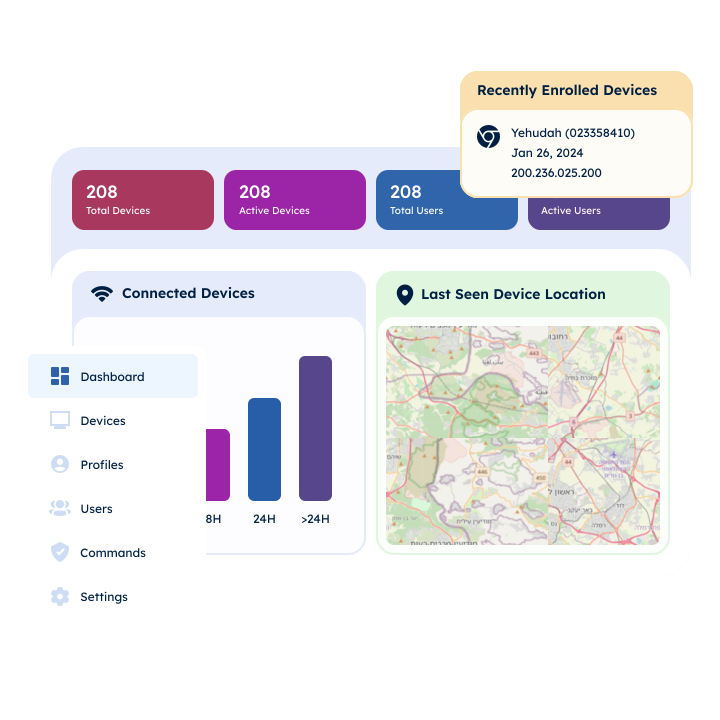
IT teams can view real-time dashboards showing CPU usage, memory, battery health, network status, and application activity across the entire fleet. This visibility empowers teams to proactively address issues before users even become aware of them.
Remote Support and Control
Radix also supports live remote screen viewing, control, and troubleshooting, reducing the need for on-site interventions. IT technicians can assist users directly, ensuring faster resolution and minimal disruption to workflows.

DevOps and Continuous Innovation: CI/CD Without Downtime
Modern IT organizations can’t afford maintenance windows or deployment freezes. Radix employs a continuous integration and continuous deployment (CI/CD) pipeline, enabling frequent and seamless updates without downtime.
Scalable by Design: Kubernetes-Powered Performance
At the heart of Radix's infrastructure lies a Kubernetes-orchestrated microservices architecture running on Amazon EKS. This design enables elastic scaling, automatically adjusting compute resources based on load. Whether you experience a surge in device check-ins or a spike in admin console activity, Radix responds in real time by dynamically provisioning additional containers. When the load drops, resources scale back down to optimize efficiency and cost.
To maintain peak responsiveness, Radix employs intelligent traffic management. NGINX ingress controllers distribute requests evenly across services and regions, preventing bottlenecks and ensuring every user interaction, whether from Tokyo or Toronto, receives near-instant feedback. The platform also isolates workloads per tenant and region, preserving local performance even under heavy global usage.
Complementing this architecture is a dual CDN strategy that accelerates both static assets (like app binaries and log files) and dynamic API traffic. By bringing content closer to the edge, Radix ensures snappy performance regardless of geography. The result? Sub-second interactions and high-throughput telemetry, delivered with consistency, even at enterprise scale.
We built the Radix platform’s data pipeline for velocity and volume. Real-time protocols, such as MQTT and WebSockets, stream telemetry data with minimal overhead, while scalable storage systems, like MongoDB Atlas and Amazon S3, handle billions of records without breaking stride. Whether you manage hundreds or hundreds of thousands of devices, Radix keeps your device management experience fast, reliable, and built for large-scale environments.
CI/CD Built for Enterprise Velocity
Radix’s commitment to agility is made possible through a robust DevOps pipeline that automates and accelerates the software development lifecycle, without sacrificing security or uptime. Leveraging Infrastructure as Code (IaC) via Terraform, every environment, from development to production, is reproducible, version-controlled, and easily auditable. This GitOps foundation ensures that infrastructure changes are consistent and traceable, enabling fast iterations with minimal risk.
The platform’s automated CI/CD pipeline is designed for both speed and safety. Each code change undergoes a rigorous series of tests, including unit, integration, and static security scans, to catch defects early. Only builds that meet stringent quality gates move forward, ensuring that every deployment is production-ready.
Always-On Innovation: Zero Downtime Releases
Thanks to containerization and orchestration, Radix can ship updates using modern deployment strategies, such as rolling updates and blue-green deployments. These methods ensure that new releases are gradual and monitored in real time. If any anomalies are detected, the platform can roll back to a stable version instantly. This allows new features, enhancements, and security patches to be deployed without taking systems offline or requiring maintenance windows.

From the user's perspective, everything simply works. Admins can continue issuing commands, and devices stay connected and responsive, even while major upgrades occur in the background.
Business Impact: Faster Resolution, Fewer Disruptions, Happier Users
This technical foundation translates into measurable business value for your IT and operations teams.
Reduced Downtime
Thanks to its resilient architecture and proactive monitoring, Radix’s MDM security features minimize service interruptions. Organizations experience fewer outages and faster recovery times when incidents do occur.
Improved User Satisfaction
Employees, students, or field workers using Radix-managed devices benefit from seamless updates, minimal latency, and responsive IT support. The result? Higher satisfaction, fewer complaints, and better productivity.
Lower Operational Costs
Radix automates numerous manual tasks, including patch deployment, threat detection, and device enrollment. Reduced downtime and faster resolution also mean less revenue lost to disruptions.
Enhanced Security Posture
With zero-trust principles, real-time telemetry, and automated threat mitigation, Radix helps organizations significantly lower their risk exposure. Security teams can focus on strategic defense rather than constantly fighting fires.
Future-Proof Your Device Management With Radix
Legacy MDM solutions are no longer enough. Today’s enterprise environments demand security-first, cloud-native platforms that can scale globally, respond instantly, and evolve continuously. Radix delivers all this and more, combining cutting-edge MDM security infrastructure with intuitive management tools to simplify even the most complex device deployments.
For IT and operations leaders, the impact of this infrastructure is profound. It delivers new capabilities, performance optimizations, and threat mitigations seamlessly and continuously. There are no drawn-out maintenance periods or delayed update cycles, Radix ensures your device management environment is always modern, always secure, and always ahead of the curve.
In a landscape where needs evolve overnight, whether due to new OS versions, compliance mandates, or emerging cyber threats, Radix empowers organizations to adapt instantly. The platform’s DevOps engine ensures you’re not just keeping up with change, but driving it.
Whether you're managing 500 or 500,000 devices, Radix gives your organization the infrastructure and control to scale confidently. Ready to experience a new era of MDM security? Request a demo today and discover how Radix can transform your remote device management strategy.
 Scaling With Confidence: Choosing the Right Android Device Management Platform for a Large Device Fleet
  Fix Technical Issues Faster: A Guide to Remote Diagnostics and Device Troubleshooting Tools
  Cutting Costs and Improving Customer Support Efficiency With Smarter Device Management
  Device Manufacturers: Embed an Android Device Management App at the Firmware Level for a Competitive Edge
  How to Get Real-Time Device Analytics on Your Device Fleet Performance (And Why It Matters)